
Material Selection Guide: Metals, Plastics, and Composites
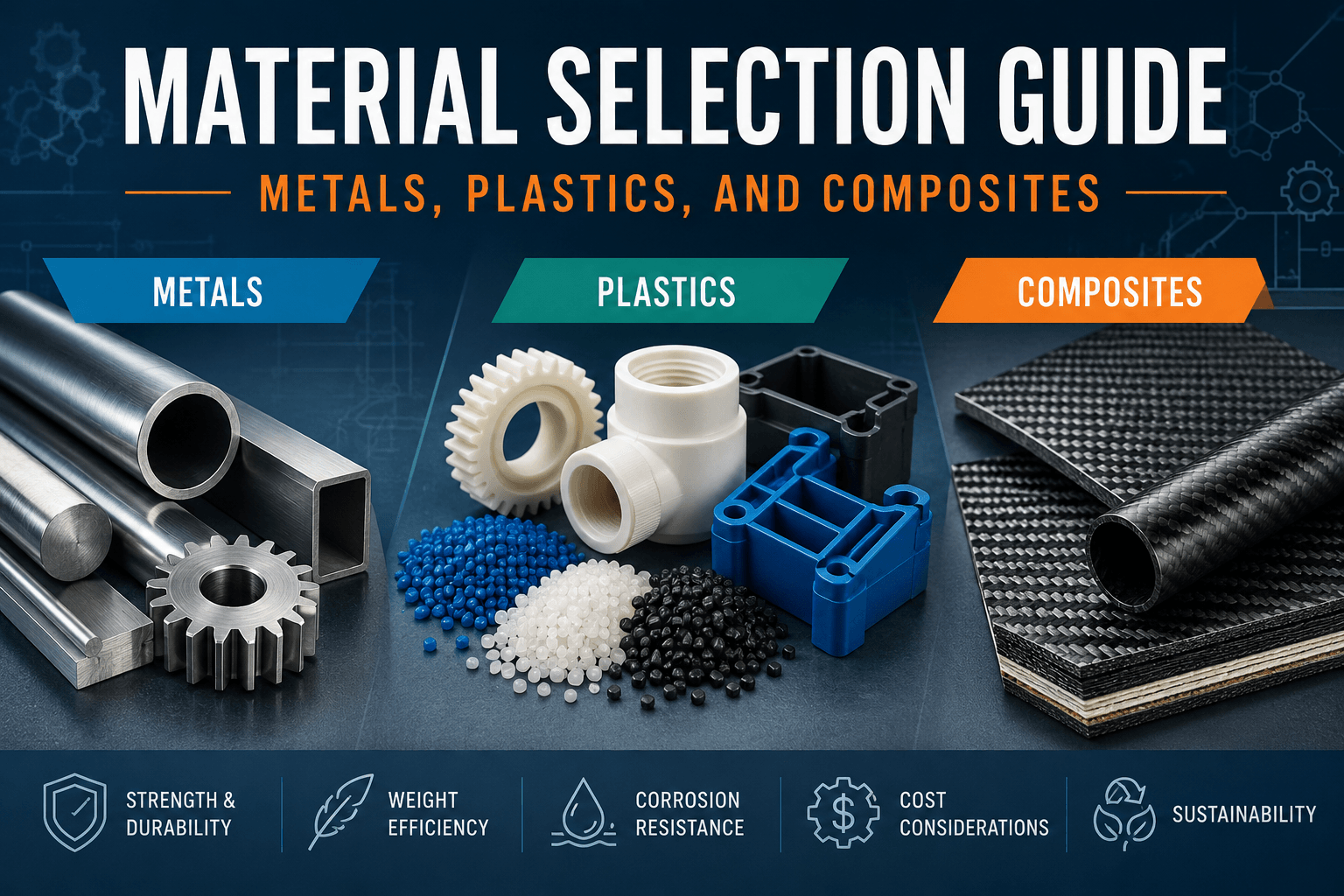
Choosing the right material is one of the most important decisions in product design and manufacturing. The material affects strength, durability, weight, manufacturing cost, maintenance requirements, and product lifespan.
There is no universal “best” material. The right choice depends on your application’s mechanical requirements, operating environment, budget, production volume, and sustainability goals.
This guide compares metals, plastics, and composites to help engineers, designers, and manufacturers make informed decisions.
Understanding the Three Material Categories
Metals
Metals are known for their strength, toughness, and ability to withstand high temperatures. They are widely used in industries such as automotive, aerospace, construction, and heavy equipment.
Common metals include:
- Steel
- Stainless steel
- Aluminum
- Copper
- Titanium
- Brass
Plastics
Plastics are lightweight polymers that offer excellent corrosion resistance and design flexibility. They are available in thousands of grades for structural, electrical, medical, and consumer applications.
Common plastics include:
- ABS
- Polycarbonate (PC)
- Nylon (PA)
- Polypropylene (PP)
- Polyethylene (PE)
- PEEK
- PVC
Composites
Composites combine two or more materials to create improved performance. Most structural composites consist of reinforcing fibers embedded in a polymer resin.
Common examples include:
- Carbon fiber reinforced polymer (CFRP)
- Glass fiber reinforced polymer (GFRP)
- Kevlar composites
- Fiberglass laminates
Comparing Material Properties
| Property | Metals | Plastics | Composites |
|---|---|---|---|
| Strength | Excellent | Moderate | Excellent |
| Weight | Heavy to moderate | Very light | Extremely light |
| Corrosion resistance | Varies by alloy | Excellent | Excellent |
| Temperature resistance | Excellent | Moderate | Moderate to high |
| Electrical conductivity | High | Low | Usually low |
| Manufacturing cost | Moderate | Low | High |
| Machinability | Good | Excellent | Challenging |
| Fatigue resistance | Good | Moderate | Excellent in many applications |
| Recyclability | Excellent | Good, depending on type | More difficult |
When to Choose Metals
Metals are often the preferred option when structural performance is the highest priority.
Typical applications include:
- Load-bearing structures
- Machine components
- Industrial equipment
- Pressure vessels
- Automotive chassis
- Aerospace structural parts
Advantages
- High mechanical strength
- Excellent wear resistance
- High temperature capability
- Long service life
- Easy to recycle
- Well-established manufacturing processes
Limitations
- Higher weight than plastics or composites
- Potential corrosion
- Higher machining costs for some alloys
- Increased transportation costs due to weight
When to Choose Plastics
Plastics are ideal when lightweight design, corrosion resistance, and low manufacturing costs are important.
Typical applications include:
- Consumer products
- Medical devices
- Electronic housings
- Packaging
- Automotive interiors
- Fluid handling systems
Advantages
- Lightweight
- Corrosion resistant
- Low material cost
- Easy to mold into complex shapes
- Good electrical insulation
- Low maintenance
Limitations
- Lower strength
- Lower heat resistance
- Can creep under continuous loads
- UV exposure may degrade some plastics
- Some grades have limited recyclability
When to Choose Composites
Composites deliver exceptional strength-to-weight ratios and are commonly used where weight savings justify higher costs.
Typical applications include:
- Aircraft structures
- Wind turbine blades
- Sporting goods
- Marine components
- High-performance vehicles
- Spacecraft
Advantages
- Extremely lightweight
- High stiffness
- Excellent fatigue resistance
- Corrosion resistant
- Tailorable mechanical properties
Limitations
- Higher material costs
- More complex manufacturing
- Difficult to repair
- Recycling remains challenging
- Longer production times
Key Factors in Material Selection
Mechanical Requirements
Evaluate:
- Tensile strength
- Yield strength
- Impact resistance
- Hardness
- Fatigue life
- Wear resistance
Heavy-duty structural applications generally favor metals or advanced composites.
Weight
Reducing weight can improve:
- Fuel efficiency
- Energy consumption
- Transportation costs
- Product ergonomics
Plastics and composites often outperform metals when lightweight construction is essential.
Environmental Conditions
Consider exposure to:
- Moisture
- Saltwater
- Chemicals
- UV radiation
- Extreme temperatures
- Abrasion
Material performance varies significantly depending on operating conditions.
Manufacturing Process
Different materials support different production methods.
Metals:
- Machining
- Casting
- Forging
- Welding
- Sheet metal fabrication
Plastics:
- Injection molding
- Blow molding
- Extrusion
- Thermoforming
- 3D printing
Composites:
- Hand layup
- Resin transfer molding
- Filament winding
- Pultrusion
- Autoclave curing
Manufacturing capabilities often influence the most practical material choice.
Cost Considerations
Material cost is only one part of the total product cost.
Also consider:
- Tooling
- Processing
- Assembly
- Maintenance
- Product lifespan
- Transportation
- End-of-life disposal
A lower-cost material may result in higher lifetime expenses if durability or maintenance becomes an issue.
Sustainability
Environmental impact is increasingly important in engineering decisions.
Metals generally offer excellent recyclability, especially aluminum and steel. Many thermoplastics can also be recycled, although recycling rates vary by resin type. Composite recycling is improving but remains more complex due to the combination of materials.
Quick Selection Guide
Choose metals when you need:
- Maximum structural strength
- High temperature resistance
- Long-term durability
- Excellent wear resistance
Choose plastics when you need:
- Lightweight components
- Corrosion resistance
- Low production cost
- High-volume manufacturing
Choose composites when you need:
- Maximum strength with minimum weight
- High fatigue performance
- Premium performance
- Corrosion resistance in demanding environments
Final Thoughts
Material selection involves balancing performance, cost, manufacturability, and sustainability. Metals remain the preferred choice for high-strength structural applications. Plastics offer cost-effective solutions for lightweight, corrosion-resistant products, while composites provide outstanding performance where weight reduction is critical.
By evaluating mechanical requirements, operating conditions, manufacturing methods, lifecycle costs, and environmental impact, engineers can select materials that deliver the best overall value for their specific application.
Frequently Asked Questions
Which material is strongest?
High-strength metals such as steel and titanium offer excellent absolute strength. Carbon fiber composites provide exceptional strength relative to their weight.
Why are plastics replacing metals in some products?
Plastics reduce weight, resist corrosion, simplify manufacturing, and often lower production costs, making them suitable for many non-structural and moderately loaded applications.
Are composites always better than metals?
No. Composites excel in applications where weight savings are critical, but they typically cost more, require specialized manufacturing, and can be more difficult to repair and recycle.
What factors matter most during material selection?
The most important considerations include mechanical performance, operating environment, weight, manufacturing process, cost, expected service life, regulatory requirements, and sustainability.