
Precision Manufacturing Processes: The Complete Guide for Engineers and Buyers
Introduction
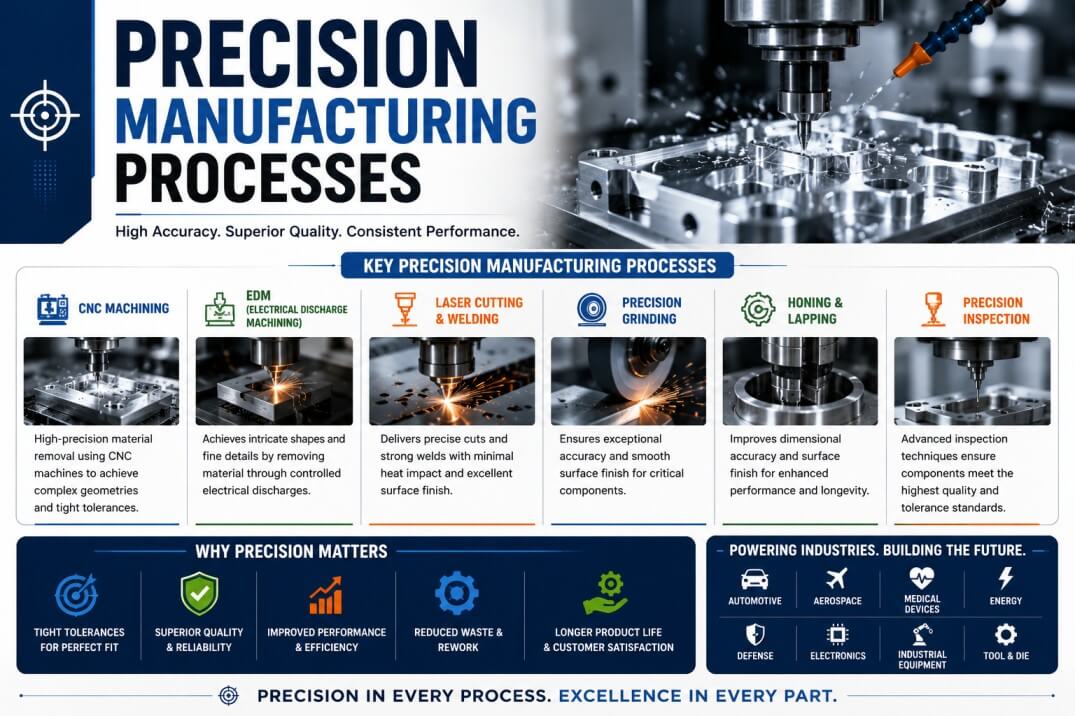
Precision manufacturing is the discipline of producing parts where dimensional accuracy, surface finish, and geometric tolerance are engineered requirements, not best-effort outcomes. A turbine blade that is 0.05mm out of profile fails. A bearing race with 0.2 micron surface finish deviation fails. A surgical implant with incorrect thread pitch fails. This guide covers the core precision manufacturing processes – what they do, what tolerances they achieve, how to specify them correctly, and how to match process to application.
What Is Precision Manufacturing?
Precision manufacturing describes processes where dimensional tolerance is at or below IT8 (typically +/- 0.02mm or tighter for critical features), surface roughness (Ra) is controlled to 1.6 micron or less for functional surfaces, and geometric tolerances (flatness, roundness, cylindricity, perpendicularity) are specified on the drawing and verified.
Applications: aerospace components, surgical instruments, optical systems, precision bearings, high-performance automotive components, semiconductor equipment, defence optics and guidance systems.
CNC Machining (Milling and Turning)
The workhorse of precision manufacturing. CNC milling removes material with rotating cutters across X-Y-Z axes; CNC turning rotates the workpiece against a stationary tool.
Achievable tolerances:
- Standard CNC: +/- 0.1-0.05mm
- Precision CNC (high-end VMC/HMC): +/- 0.02-0.01mm
- Ultra-precision CNC (diamond turning): +/- 0.001mm (1 micron)
Surface finish: Ra 0.8-3.2 micron standard; Ra 0.4 micron with fine finishing passes and sharp tooling.
Best for: Prismatic and rotational parts, complex geometries, multi-feature components, materials from aluminium to titanium, Inconel, and hardened steels.
Specifying correctly: Define GD&T (Geometric Dimensioning and Tolerancing) per ASME Y14.5 on the drawing. Specify tolerance grade (IT grade) on critical features. Avoid specifying tighter tolerances than needed – every tightening of tolerance increases cost non-linearly.
CNC Grinding
Grinding uses abrasive wheels to remove material at micron-level precision, achieving tolerances beyond standard CNC machining.
Process variants:
- Cylindrical grinding: External and internal diameters; used for shafts, bearing races, hydraulic cylinders
- Surface grinding: Flat surfaces; used for mould bases, gauge blocks, precision plates
- Centreless grinding: High-volume cylindrical grinding without centres; used for pins, rollers, valve stems
- Profile/form grinding: Complex profiles ground to shape; used for gears, cams, thread grinding
Achievable tolerances: +/- 0.005-0.002mm on diameter; roundness and cylindricity to 0.001mm. Surface finish: Ra 0.4-0.1 micron standard; Ra 0.025 micron with superfinish grinding.
Best for: Hardened materials (55 HRC and above), bearing surfaces, sealing surfaces, high-precision shafts.
EDM (Electrical Discharge Machining)
EDM removes material by controlled electrical discharge (spark erosion) between the tool electrode and workpiece. No mechanical cutting force – uniquely suited for hardened materials, complex cavities, and fragile workpieces.
Process variants:
- Sinker EDM (Ram EDM): Shaped electrode sinks into workpiece to create cavity. Used for injection mould cavities, die casting dies, turbine blade cooling holes.
- Wire EDM: Thin wire (0.1-0.3mm) cuts through workpiece following CNC path. Used for precision profiles, carbide punches, complex 2D extrusions through 3D parts.
Achievable tolerances: +/- 0.005-0.002mm; wire EDM achieves +/- 0.001mm on profile. Surface finish: Ra 0.8-0.2 micron; mirror finish achievable with VDI 0 EDM settings. Material limitation: Workpiece must be electrically conductive.
Honing
Honing uses abrasive stones reciprocating within a bore to correct geometry errors and improve surface finish. It is not a dimensional removal process – it is a geometry and finish correction process.
Achievable: Cylindricity correction to 0.002mm; surface finish Ra 0.2-0.05 micron with crosshatch pattern. Best for: Engine cylinder bores, hydraulic cylinders, pneumatic cylinders, bearing housings. The crosshatch pattern left by honing retains lubricant – this is a functional feature, not a cosmetic one.
Lapping and Polishing
Lapping uses loose abrasive in a carrier fluid between a lapping plate and workpiece surface to produce extremely flat, smooth surfaces. Polishing uses progressively finer abrasives to achieve mirror finishes.
Lapping achievable: Flatness to 0.0001mm (0.1 micron); Ra 0.025 micron and below. Polishing achievable: Ra 0.01 micron (10nm) – optical-grade surface finish. Best for: Gauge blocks, optical flats, valve seats, precision bearing faces, hydraulic valve spools, semiconductor wafer carriers.
Tolerances: How Tight Is Tight Enough?
ISO tolerance system (IT grades):
- IT14-IT16 (Rough): Castings, forgings as-cast/as-forged
- IT11-IT13 (Medium): General machining, structural parts
- IT8-IT10 (Precision): Standard CNC machining, fits and shafts
- IT5-IT7 (High Precision): CNC with grinding/lapping, bearing fits
- IT2-IT4 (Ultra Precision): Gauge blocks, master standards
Cost impact of tolerance tightening: +/-0.5mm (IT12) = 1x base cost | +/-0.1mm (IT10) = 1.5x | +/-0.02mm (IT8) = 3x | +/-0.005mm (IT6) = 8x | +/-0.001mm (IT4) = 25x
Specify the tolerance your function requires – not tighter. Engineers who default to “+/- 0.01mm on everything” drive cost 5-10x higher than the design requires.
Surface Finish: Ra, Rz, and What the Numbers Mean
Ra (arithmetic mean roughness): Most common surface finish parameter. Useful for general surface quality specification.
Rz (mean peak-to-valley height): Better for sealing surface specification. Two surfaces with the same Ra can have very different Rz.
Rsk (skewness): Whether peaks or valleys dominate. Negative skewness (more valleys) is preferred for lubricated surfaces (oil retention).
Specify Ra AND Rz for sealing, bearing, and lubricated surfaces. Specifying Ra alone is insufficient for safety-critical applications.
Material Selection for Precision Parts
- Aluminium 6061/7075: Excellent machinability – high speed, fine finish achievable
- Mild Steel (1018): Good machinability – standard machining
- Stainless 304/316: Moderate machinability – work-hardens; requires sharp tooling
- Hardened Steel (above 50HRC): Poor machinability – grinding only; no conventional machining above ~50HRC
- Titanium 6Al-4V: Difficult – low thermal conductivity; requires coolant, slow feeds
- Inconel 718: Very Difficult – work-hardens severely; expensive tooling, slow
- Brass/Bronze: Excellent machinability – good for small precision parts
DfM for Precision Parts: Common Specification Errors
- Under-specifying GD&T: Dimensions without GD&T callouts rely on “general tolerances” which are often too loose for precision applications.
- Conflicting tolerances: A chain of tight tolerances that mathematically cannot all be simultaneously achievable. Run tolerance stack-up analysis before releasing drawings.
- Ignoring finishing sequence: For ground surfaces, specify “grind after heat treatment.” Dimensions on drawings represent final dimensions.
- Surface finish on non-functional surfaces: Applying Ra 0.8 micron to all surfaces when only bore and mating face require it. Each precision finish operation costs money.
Key Takeaways
- Precision manufacturing processes – CNC machining, grinding, EDM, honing, lapping – each serve specific accuracy and surface finish ranges; process selection should be driven by tolerance and finish requirements.
- IT grade tolerance specification provides a systematic language; IT8 is standard precision CNC, IT5-7 requires grinding.
- Tightening tolerance from IT10 to IT6 can multiply part cost 5-8x; specify the tolerance the function needs.
- Surface finish specification should include Ra and Rz for sealing and lubricated surfaces; Ra alone is insufficient.
- DfM review of precision drawings before release catches conflicting tolerances, unachievable callouts, and unnecessary cost drivers.
FAQs
Q: What is the difference between precision and ultra-precision manufacturing?
A: Precision manufacturing achieves tolerances of +/- 0.01-0.05mm and Ra at or below 0.8 micron. Ultra-precision manufacturing achieves +/- 0.001mm (1 micron) or better, and Ra at or below 0.025 micron. Ultra-precision requires diamond turning, air-bearing spindles, and temperature-controlled environments.
Q: Can CNC machining replace grinding for precision shafts?
A: For shafts requiring IT7 or better and Ra at or below 0.4 micron, grinding is required after CNC turning. CNC alone cannot reliably achieve cylindricity of 0.002mm or below on hardened materials. The two processes are complementary, not substitutes.
Q: How do I specify precision requirements on a drawing correctly?
A: Use GD&T (ASME Y14.5 or ISO 1101) for geometric tolerances. Specify dimensional tolerances using +/- values or IT grade for critical features. Specify surface finish with Ra (and Rz for sealing surfaces). Include datum references so the manufacturer knows the reference frame for measurements.