
Electronics Manufacturing Services (EMS) in India: The Complete 2026 Guide
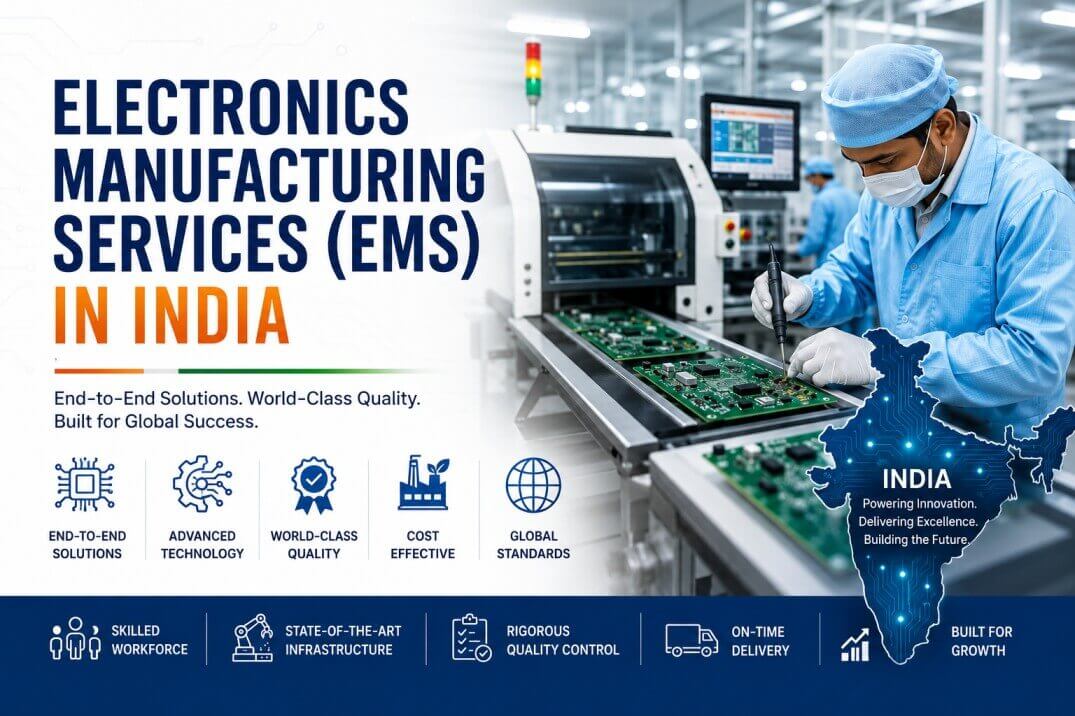
India assembled its first iPhone in 2017. By 2025, Apple’s Indian production crossed INR 2 trillion – an 85% jump in a single year – representing roughly 25% of global iPhone output. What happened in those eight years is one of the most consequential industrial stories of the decade: India became a credible, large-scale electronics manufacturing destination, and the EMS ecosystem that built up around that transformation is now available to any OEM in the world.
This guide covers what Electronics Manufacturing Services providers in India actually offer, why India’s cost and policy environment makes it compelling, what the EMS market looks like, which industries are being served, and how to choose a partner.
What Are Electronics Manufacturing Services?
EMS refers to the design, manufacture, testing, and logistics services that contract manufacturers provide to electronics OEMs who outsource production. An EMS provider does not own the product design – that belongs to the OEM. They own the process expertise, equipment, supply chain relationships, and facilities that turn the OEM’s design into a shipping product.
EMS vs. OEM vs. ODM: Key Differences
- EMS provider: Builds to the OEM’s design. No product ownership.
- OEM (Original Equipment Manufacturer): Designs and brands the product; may manufacture or outsource production.
- ODM (Original Design Manufacturer): Designs the product and manufactures it; OEM buys finished product, often white-labelled.
Zetwerk and the EMS providers in its network operate on the EMS model – building to client specifications with no claim on product design or IP.
The Full Scope of EMS: Design Through Distribution
Modern EMS is not just assembly. Full-service EMS providers support the complete product lifecycle:
- Design support: DfM review, PCB layout advisory, component selection optimisation
- Prototyping and NPI: New Product Introduction, engineering validation builds
- PCB assembly: SMT and through-hole, AOI, X-ray, ICT
- Box build and system integration: Mechanical assembly, cable harness, final product integration
- Testing: Functional test, environmental stress screening, burn-in
- Component sourcing: Global BOM procurement, approved vendor list management
- Distribution: Warehousing, VMI, JIT delivery, repair and refurbishment
What EMS Companies in India Actually Provide
PCB Assembly (SMT and Through-Hole)
India’s EMS sector has invested heavily in surface mount technology lines – automated pick-and-place, solder paste inspection, reflow ovens, and automated optical inspection. SMT is the dominant technology for consumer electronics, wearables, and industrial electronics. Through-hole capability is maintained for connectors, power components, and applications requiring mechanical strength.
Box Build and System Integration
Beyond the PCB, box build encompasses mechanical assembly, cable harness integration, sub-assembly mating, and final product build. India’s EMS providers combine electronics assembly with mechanical fabrication capability – including sheet metal, die casting, and plastics – to deliver fully integrated products.
Component Sourcing and BOM Management
Component sourcing is a strategic capability. India’s EMS providers maintain global supply chain relationships – with distributors and manufacturers in Asia, Europe, and North America – to procure to approved vendor lists, manage component obsolescence, and mitigate shortage risk. Vendor-managed inventory (VMI) and just-in-time delivery reduce the OEM’s working capital requirements.
Testing: ICT, Functional, Environmental
Production testing in Indian EMS follows IPC standards:
- In-Circuit Testing (ICT): Electrical connectivity, component values, and shorts
- Functional Testing: Full product operation under simulated end-use conditions
- Automated Optical Inspection (AOI) and X-ray: Solder joint quality and hidden defect detection
- Environmental Stress Screening: Temperature cycling, vibration, humidity – required for automotive and industrial products
Repair and After-Sales Services
Leading Indian EMS providers offer repair depots and refurbishment services for warranty and post-warranty returns – extending the EMS relationship from build to product lifecycle management.
Why India Is Winning in Electronics Manufacturing
Labour Cost Advantage Over China
India’s EMS labour costs average USD 3/hour compared to China’s USD 5.80/hour. For labour-intensive assembly operations – wearables, hearables, industrial products with high touch-content – this delta is significant at volume.
Engineering Talent Pool: 1.5M+ STEM Graduates Per Year
India’s engineering talent pipeline is one of the world’s deepest. Electronics engineering, embedded systems, and test engineering talent is available in large volumes in Chennai, Hyderabad, Bangalore, and Pune – the same cities with strong EMS infrastructure. This technical talent base supports DfM, NPI, and test development work that many EMS providers in other low-cost geographies cannot match.
PLI Scheme: 4-6% Incentive on Incremental Production
India’s Production Linked Incentive scheme for Large Scale Electronics Manufacturing provides a 4–6% financial incentive on incremental production above a base year threshold. This incentive has driven Foxconn, Pegatron, Rising Star (iPhone supply chain), Lava, Dixon, and others to invest in India EMS capacity. It translates to a meaningful pricing advantage for OEMs sourcing from PLI-registered EMS providers.
ECMS 2025: India’s ₹22,919 Cr Component Manufacturing Push
The Electronics Component Manufacturing Scheme approved in 2025 specifically targets the component gap in India’s EMS ecosystem – PCBs, SMD passives, lithium-ion cells, and other foundational components. This policy signals a deliberate effort to build component depth that will further reduce India’s EMS cost structure over the next 5 years.
India’s EMS Market: Size, Growth, and Key Players
Market Overview
India’s electronics production grew from ₹1.9 lakh crore in 2014–15 to ₹11.3 lakh crore in 2024–25 – a six-fold increase over ten years. Electronics exports rose from ₹38,000 crore to ₹3.27 lakh crore in the same period. The EMS sector is at the centre of this growth.
The India EMS market is growing at a CAGR above 20%, driven by mobile phones, wearables, IT hardware, and automotive electronics.
Key Capability Categories
India’s EMS ecosystem covers:
- High-volume consumer electronics: Mobile phones, tablets, laptops, earbuds, smartwatches
- Industrial and B2B electronics: Smart meters, inverters, industrial controls, telecom equipment
- Automotive electronics: EV charging controllers, ADAS sensors, infotainment systems
- Aerospace and defence electronics: Avionics, radar sub-systems, defence communications equipment
Industries Driving EMS Demand in India
Consumer Electronics (Smartphones, Laptops, Wearables)
Mobile phones account for the largest share of India’s EMS output. Laptop and IT hardware manufacturing is growing rapidly under PLI. Wearables – smartwatches, earbuds, fitness bands – are an emerging high-growth segment with strong domestic demand.
Automotive and EV Electronics
As India’s automotive sector transitions to electric vehicles, the demand for EV power electronics, battery management systems, charging infrastructure, and ADAS components is growing significantly. India’s automotive electronics EMS market is projected to grow at above 25% annually through 2030.
Telecom and Networking Equipment
India’s 5G rollout is driving demand for telecom equipment manufacturing. India has set explicit domestic manufacturing content requirements for government telecom procurement – a structural demand driver for domestic EMS.
Aerospace and Defence Electronics
India’s private aerospace and defence manufacturing sector is growing rapidly under liberalised FDI rules and indigenisation targets. Avionics assemblies, defence communication systems, and radar sub-systems are being manufactured by Indian EMS companies with AS9100 and NADCAP certification.
Industrial Controls and Smart Meters
India’s smart grid rollout and industrial automation adoption are driving demand for smart meters, SCADA controllers, and industrial IoT devices – all manufactured through EMS.
EMS for Wearables and Hearables: India’s Emerging Edge
The wearables and hearables market is one of the fastest-growing segments of consumer electronics globally – and one where India has built genuine EMS capability.
Smartwatch and Earbuds Manufacturing Landscape
Brands like boAt, Noise, and Boat have built global-scale wearables brands manufactured entirely in India. The EMS ecosystem supporting them – PCB assembly for miniaturised boards, precision die casting for chassis, injection moulding for housings, battery integration, and functional testing – is now available to global OEMs looking to produce wearables in India.
IoT Devices and Smart Home Products
The IoT product category – smart home devices, connected sensors, edge computing hardware – requires EMS capability in small-form-factor PCB assembly, wireless module integration (Wi-Fi, Bluetooth, Zigbee), and firmware flashing. Indian EMS providers are increasingly competent in this category.
Key Capabilities Required for Wearable EMS
- Ultra-miniature SMT (0201 and 01005 component capability)
- Flexible PCB assembly
- Battery integration and safety testing
- Waterproofing and IP rating processes
- Cosmetic-grade mechanical finishing
Full Product Lifecycle Manufacturing – The Platform Model
From Concept to Prototype: Design for Manufacturability
Before a single unit is assembled, DfM review identifies design choices that will drive cost, quality risk, or supply chain complexity. Fixing a component selection or PCB layout at DfM stage costs a fraction of what it costs to fix in production.
NPI: New Product Introduction and First Article Inspection
NPI is the structured process of moving from approved design to qualified production. In India’s EMS ecosystem, NPI includes engineering validation builds (EVT), design validation builds (DVT), production validation builds (PVT), and First Article Inspection – each stage adding production confidence before volume ramp.
Mass Production, VMI, and JIT Delivery
At production scale, India’s EMS providers offer vendor-managed inventory programmes – where the EMS provider holds safety stock of critical components – and just-in-time delivery to the OEM’s demand signal. Zetwerk’s platform delivers JIT lead times as fast as five days for pre-stocked materials.
After-Sales Repair and Refurbishment
A full-service EMS partnership extends to after-sales: warranty repair, component-level rework, refurbishment for return-to-market, and end-of-life processing. This keeps the EMS partner engaged through the full product lifecycle rather than just the manufacturing phase.
EMS Cost Breakdown: India vs. China vs. Vietnam
| Cost Component | India | China | Vietnam |
|---|---|---|---|
| Labour (assembly) | Low | Medium | Low |
| Engineering talent | High availability, competitive cost | High availability, higher cost | Limited availability |
| PLI subsidy | 4–6% | None | None |
| Component sourcing | Mostly global/Asian supply chain | Strong domestic ecosystem | Mostly imported |
| Logistics to US/EU | Slightly longer | Shorter | Similar to India |
| IP risk | Managed | Higher | Managed |
| Language | English strong | English limited | English limited |
India’s total landed cost advantage over China for EMS work has narrowed as China’s wages have risen – but the PLI subsidy, English proficiency, and geopolitical safety advantage have shifted the calculus meaningfully in India’s favour for a broad range of electronics categories.
How to Choose the Right EMS Partner in India
Certifications to Require
- ISO 9001 – baseline QMS
- IPC-A-610 – electronics workmanship
- J-STD-001 – soldering
- IATF 16949 – if automotive
- AS9100 – if aerospace or defence
- ISO 13485 – if medical devices
8 Evaluation Criteria for EMS Selection
- SMT capability: line count, component size range, throughput
- Through-hole and mixed-technology capability
- Inspection suite: AOI, X-ray, ICT
- Component sourcing breadth and BOM management
- NPI process rigour and DfM capability
- Quality certifications and audit records
- Capacity and lead time track record
- Digital visibility and reporting tools
Questions to Ask During RFQ
- What is your SMT component placement accuracy and yield rate?
- What is your average BOM lead time from RFQ to first article?
- Can you demonstrate NPI builds for products of similar complexity?
- How do you manage component shortage risk?
- What is your repair/rework rate in production?
Key Takeaways
- India’s EMS market is growing above 20% annually – driven by PLI incentives, rising global EMS demand, and a deepening capability ecosystem
- Core EMS services span PCB assembly, box build, component sourcing, testing, and distribution
- Labour cost, STEM talent, PLI incentives, and IP law alignment give India structural EMS advantages
- Wearables, automotive electronics, telecom, and defence are the highest-growth EMS segments
- Full product lifecycle EMS – design support through repair – is available from India’s leading providers
- Platform-based EMS (Zetwerk) provides pre-vetted access to this ecosystem with production visibility and accountability
FAQs
Q. What types of products can India’s EMS providers manufacture?
Consumer electronics, industrial controls, automotive electronics, defence/aerospace systems, medical devices, telecom equipment, wearables, IoT devices, and IT hardware – the full range of electronics product categories.
Q. How does the PLI scheme benefit OEMs sourcing EMS from India?
PLI provides Indian EMS companies a 4–6% financial incentive on incremental production, which is partially reflected in competitive pricing. For significant programmes, an OEM can structure production with a PLI-registered EMS provider to capture meaningful cost advantages.
Q. What is the typical lead time for PCB assembly in India?
Prototypes and NPI builds: 2–4 weeks. Production runs: 4–8 weeks from PO, depending on component lead times. Pre-stocked materials on platforms like Zetwerk can deliver JIT in 5 days.